If you own a small business, you've probably heard terms like general liability insurance and Business Owners Policy (BOP) thrown around.
They sound similar, and both can be important pieces of business insurance. But they aren't the same thing.
The easiest way to think about it is this:
General liability primarily protects your business against certain claims made by other people. A BOP typically combines general liability with coverage for your business's own property and other common risks.
So, which one does your business actually need?
Let's break it down.
What Is General Liability Insurance?
Commercial General Liability (CGL) insurance is one of the most common coverages purchased by businesses.
It can help protect your business when you're legally responsible for things such as:
- Bodily injury — A customer slips and falls at your business or is injured because of your operations.
- Property damage — Your business accidentally damages someone else's property.
- Personal and advertising injury — Certain claims involving things like libel, slander or advertising injury.
- Legal defense costs — Defense expenses for covered lawsuits, subject to the terms of your policy.
For example, imagine you own a contracting business and accidentally damage a customer's property while completing a job. Or perhaps a customer visits your office and is injured in a fall.
Those are the types of situations where general liability coverage may come into play.
But here's an important distinction:
General liability isn't designed to insure everything your business owns.
That's where a BOP can become important.
What Is a Business Owners Policy (BOP)?
A Business Owners Policy — commonly called a BOP — packages several important business coverages into one policy.
A typical BOP combines:
General Liability Insurance
Plus
Commercial Property Insurance
And often
Business Income Coverage
Instead of purchasing these coverages separately, eligible small and midsize businesses may be able to package them together.
Commercial Property
This can help cover property your business owns, depending on the policy.
That might include:
- Buildings
- Furniture
- Computers
- Equipment
- Inventory
- Other business personal property
If a covered fire damages your office and destroys your computers, for example, general liability isn't intended to replace your computers.
The property portion of a BOP may be.
Business Income
What happens if that same fire forces your business to close temporarily?
Replacing damaged property is only part of the problem. Your business may also be losing revenue while continuing to have expenses.
Business income coverage can help replace certain lost income and continuing expenses when your operations are interrupted because of a covered loss.
The exact coverage and limitations vary by policy, which is why reviewing the details matters.
General Liability vs. BOP: What's the Difference?
Here's a simple way to compare them:
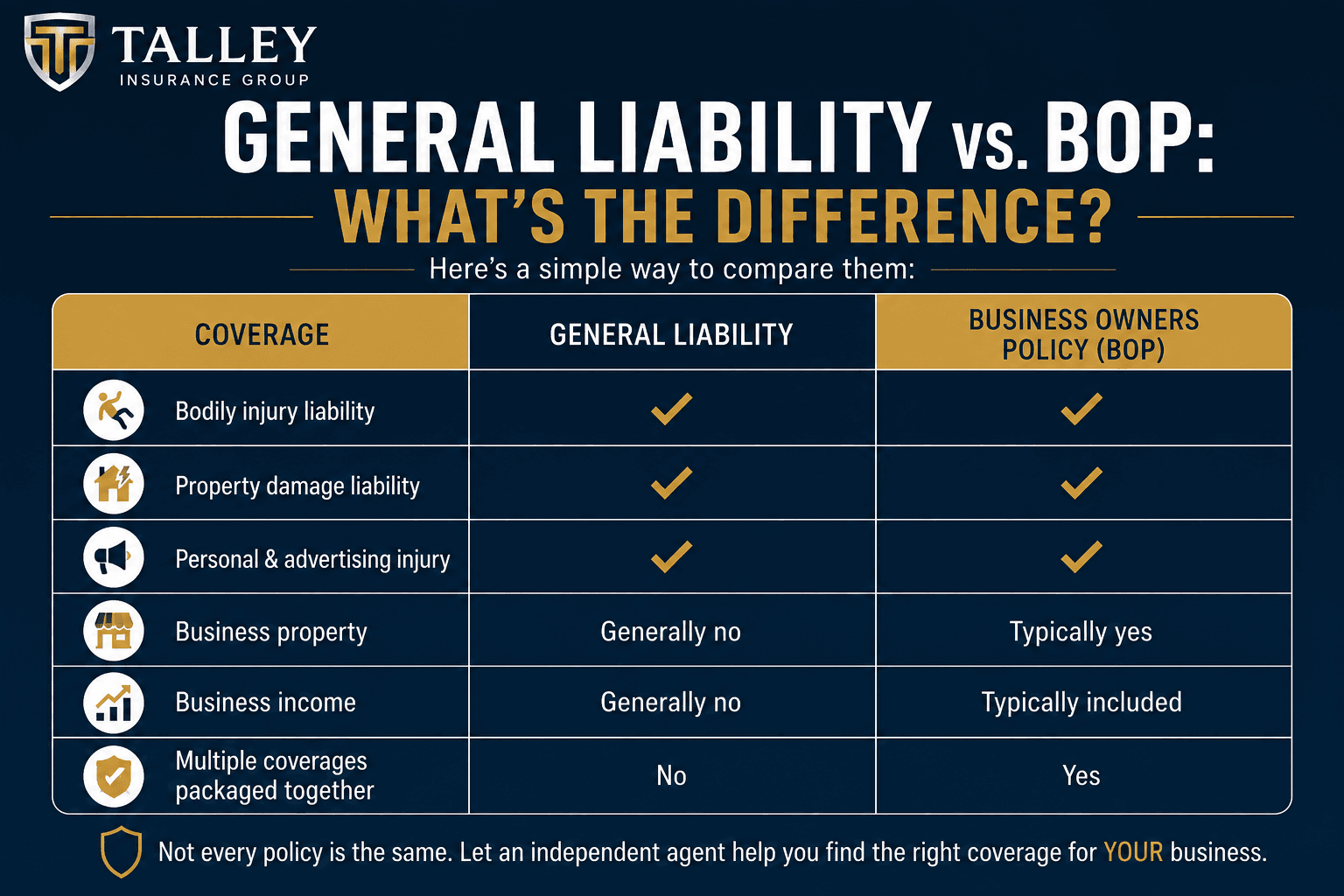
A BOP essentially provides a broader package of common business coverages, while a standalone general liability policy is more focused.
That doesn't automatically mean a BOP is better.
The right option depends on your business.
When Might General Liability Be Enough?
Some businesses don't have much physical property to insure.
For example, a service-based business might operate without a storefront, significant equipment or inventory.
In a situation like that, standalone general liability may make sense.
General liability may also be appropriate when a business's property or other exposures need to be insured separately.
When Should You Consider a BOP?
A BOP may make sense if your business has physical assets or would be significantly affected by having to temporarily shut down after a covered loss.
Examples could include:
- Retail stores
- Offices
- Restaurants
- Certain contractors
- Salons and barbershops
- Professional service businesses
- Small warehouses
- Other eligible small businesses
Eligibility varies between insurance companies. Your industry, revenue, property, location, claims history and other factors can determine whether a carrier will offer your business a BOP.
What Doesn't a BOP Automatically Cover?
This is where business insurance can get confusing.
A BOP can provide broad protection, but it isn't an all-in-one policy for every risk your business faces.
Depending on your operations, you may still need additional coverage such as:
- Workers' compensation
- Commercial auto
- Professional liability / Errors & Omissions
- Cyber liability
- Employment Practices Liability (EPLI)
- Commercial umbrella or excess liability
- Equipment breakdown
- Inland marine
- Industry-specific coverage
For example, putting your company vehicles on a BOP doesn't automatically give them commercial auto coverage. Likewise, general liability generally isn't a substitute for professional liability coverage if a customer alleges that your professional advice or services caused them a financial loss.
Don't Choose Business Insurance Based Only on Price
One of the easiest mistakes to make when shopping for business insurance is comparing two premiums without comparing what you're actually buying.
A $700 general liability policy and a $1,400 BOP aren't necessarily competing versions of the same product.
One may provide liability coverage only, while the other may include property, business income and additional protections.
The better question isn't:
"Which policy is cheaper?"
It's:
"What could financially hurt my business, and which policy protects me from those risks?"
Every Business Is Different
A contractor doesn't have the same risks as a restaurant.
A restaurant doesn't have the same risks as an accounting firm.
And an accounting firm doesn't have the same risks as a retail store.
That's why business insurance shouldn't be treated as a one-size-fits-all product.
At Talley Insurance Group, we're an independent insurance agency. That means we can evaluate your business, identify the exposures that matter and compare options from multiple insurance carriers rather than trying to fit every business into one company's policy.
Whether you need standalone general liability, a Business Owners Policy or a more customized commercial insurance package, the goal is the same:
Make sure you understand what you're paying for — and what will actually be there when your business needs it.
Need Help Reviewing Your Business Insurance?
Already have a commercial policy? We can review your current coverage and help identify potential gaps or areas worth comparing.
Starting a business or shopping for new coverage? We can help determine what types of insurance make sense based on how your business actually operates.
Talley Insurance Group
Independent Insurance Solutions for Your Business
615-241-8823
TalleyInsuranceGroup.com
Share this post